
ZO Future Group's (HKG:2309) top holders are insiders and they are likely disappointed by the recent 12% drop
Key Insights
- Insiders appear to have a vested interest in ZO Future Group's growth, as seen by their sizeable ownership
- 53% of the business is held by the top 2 shareholders
- Ownership research, combined with past performance data can help provide a good understanding of opportunities in a stock
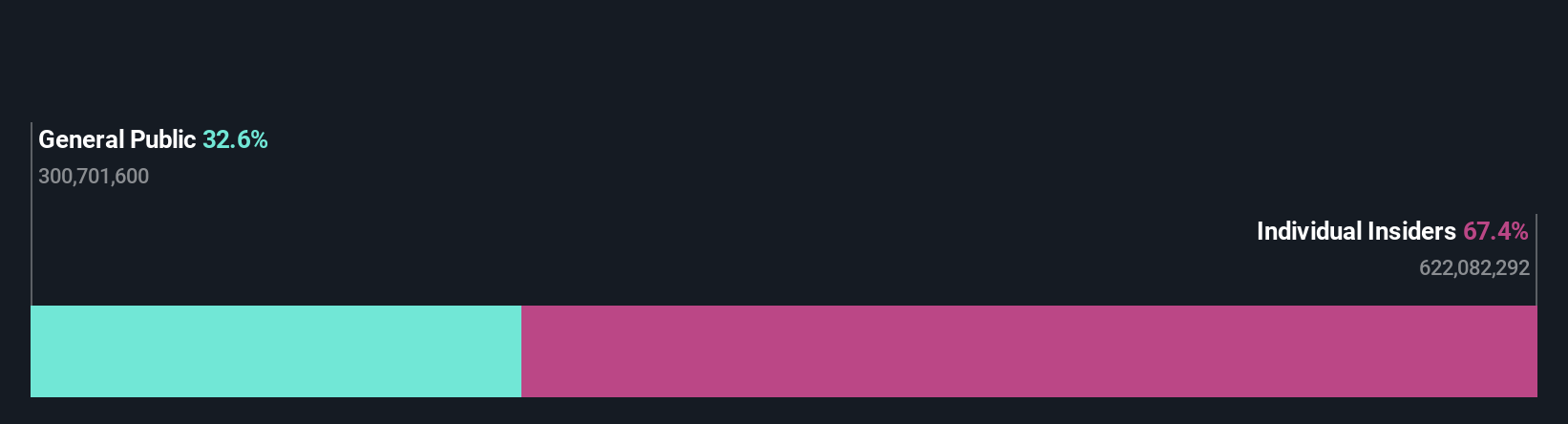
If you want to know who really controls ZO Future Group (HKG:2309), then you'll have to look at the makeup of its share registry. And the group that holds the biggest piece of the pie are individual insiders with 67% ownership. In other words, the group stands to gain the most (or lose the most) from their investment into the company.
As a result, insiders as a group endured the highest losses after market cap fell by HK$221m.
In the chart below, we zoom in on the different ownership groups of ZO Future Group.
See our latest analysis for ZO Future Group
What Does The Lack Of Institutional Ownership Tell Us About ZO Future Group?
We don't tend to see institutional investors holding stock of companies that are very risky, thinly traded, or very small. Though we do sometimes see large companies without institutions on the register, it's not particularly common.
There are multiple explanations for why institutions don't own a stock. The most common is that the company is too small relative to funds under management, so the institution does not bother to look closely at the company. It is also possible that fund managers don't own the stock because they aren't convinced it will perform well. ZO Future Group's earnings and revenue track record (below) may not be compelling to institutional investors -- or they simply might not have looked at the business closely.

Hedge funds don't have many shares in ZO Future Group. Looking at our data, we can see that the largest shareholder is Pech Vong with 30% of shares outstanding. For context, the second largest shareholder holds about 24% of the shares outstanding, followed by an ownership of 14% by the third-largest shareholder.
To make our study more interesting, we found that the top 2 shareholders have a majority ownership in the company, meaning that they are powerful enough to influence the decisions of the company.
While it makes sense to study institutional ownership data for a company, it also makes sense to study analyst sentiments to know which way the wind is blowing. As far as we can tell there isn't analyst coverage of the company, so it is probably flying under the radar.
Insider Ownership Of ZO Future Group
The definition of company insiders can be subjective and does vary between jurisdictions. Our data reflects individual insiders, capturing board members at the very least. Company management run the business, but the CEO will answer to the board, even if he or she is a member of it.
Insider ownership is positive when it signals leadership are thinking like the true owners of the company. However, high insider ownership can also give immense power to a small group within the company. This can be negative in some circumstances.
It seems that insiders own more than half the ZO Future Group stock. This gives them a lot of power. Given it has a market cap of HK$1.6b, that means they have HK$1.1b worth of shares. It is good to see this level of investment. You can check here to see if those insiders have been buying recently.
General Public Ownership
The general public-- including retail investors -- own 33% stake in the company, and hence can't easily be ignored. This size of ownership, while considerable, may not be enough to change company policy if the decision is not in sync with other large shareholders.
Next Steps:
It's always worth thinking about the different groups who own shares in a company. But to understand ZO Future Group better, we need to consider many other factors.
Many find it useful to take an in depth look at how a company has performed in the past. You can access this detailed graph of past earnings, revenue and cash flow.
Of course this may not be the best stock to buy. Therefore, you may wish to see our free collection of interesting prospects boasting favorable financials.
NB: Figures in this article are calculated using data from the last twelve months, which refer to the 12-month period ending on the last date of the month the financial statement is dated. This may not be consistent with full year annual report figures.
Have feedback on this article? Concerned about the content? Get in touch with us directly. Alternatively, email editorial-team (at) simplywallst.com.
This article by Simply Wall St is general in nature. We provide commentary based on historical data and analyst forecasts only using an unbiased methodology and our articles are not intended to be financial advice. It does not constitute a recommendation to buy or sell any stock, and does not take account of your objectives, or your financial situation. We aim to bring you long-term focused analysis driven by fundamental data. Note that our analysis may not factor in the latest price-sensitive company announcements or qualitative material. Simply Wall St has no position in any stocks mentioned.
Contact Us
Contact Number :+852 3852 8500Webull Securities Limited is licensed with the Securities and Futures Commission of Hong Kong (CE No. BNG700) for carrying out Type 1 License for Dealing in Securities, Type 2 License for Dealing in Futures Contracts and Type 4 License for Advising on Securities.

English