
Is Chi Ho Development Holdings (HKG:8423) A Risky Investment?
Legendary fund manager Li Lu (who Charlie Munger backed) once said, 'The biggest investment risk is not the volatility of prices, but whether you will suffer a permanent loss of capital.' So it might be obvious that you need to consider debt, when you think about how risky any given stock is, because too much debt can sink a company. We can see that Chi Ho Development Holdings Limited (HKG:8423) does use debt in its business. But the real question is whether this debt is making the company risky.
Why Does Debt Bring Risk?
Debt assists a business until the business has trouble paying it off, either with new capital or with free cash flow. Ultimately, if the company can't fulfill its legal obligations to repay debt, shareholders could walk away with nothing. While that is not too common, we often do see indebted companies permanently diluting shareholders because lenders force them to raise capital at a distressed price. By replacing dilution, though, debt can be an extremely good tool for businesses that need capital to invest in growth at high rates of return. When we think about a company's use of debt, we first look at cash and debt together.
What Is Chi Ho Development Holdings's Debt?
As you can see below, Chi Ho Development Holdings had HK$95.8m of debt, at March 2025, which is about the same as the year before. You can click the chart for greater detail. However, it does have HK$25.7m in cash offsetting this, leading to net debt of about HK$70.2m.
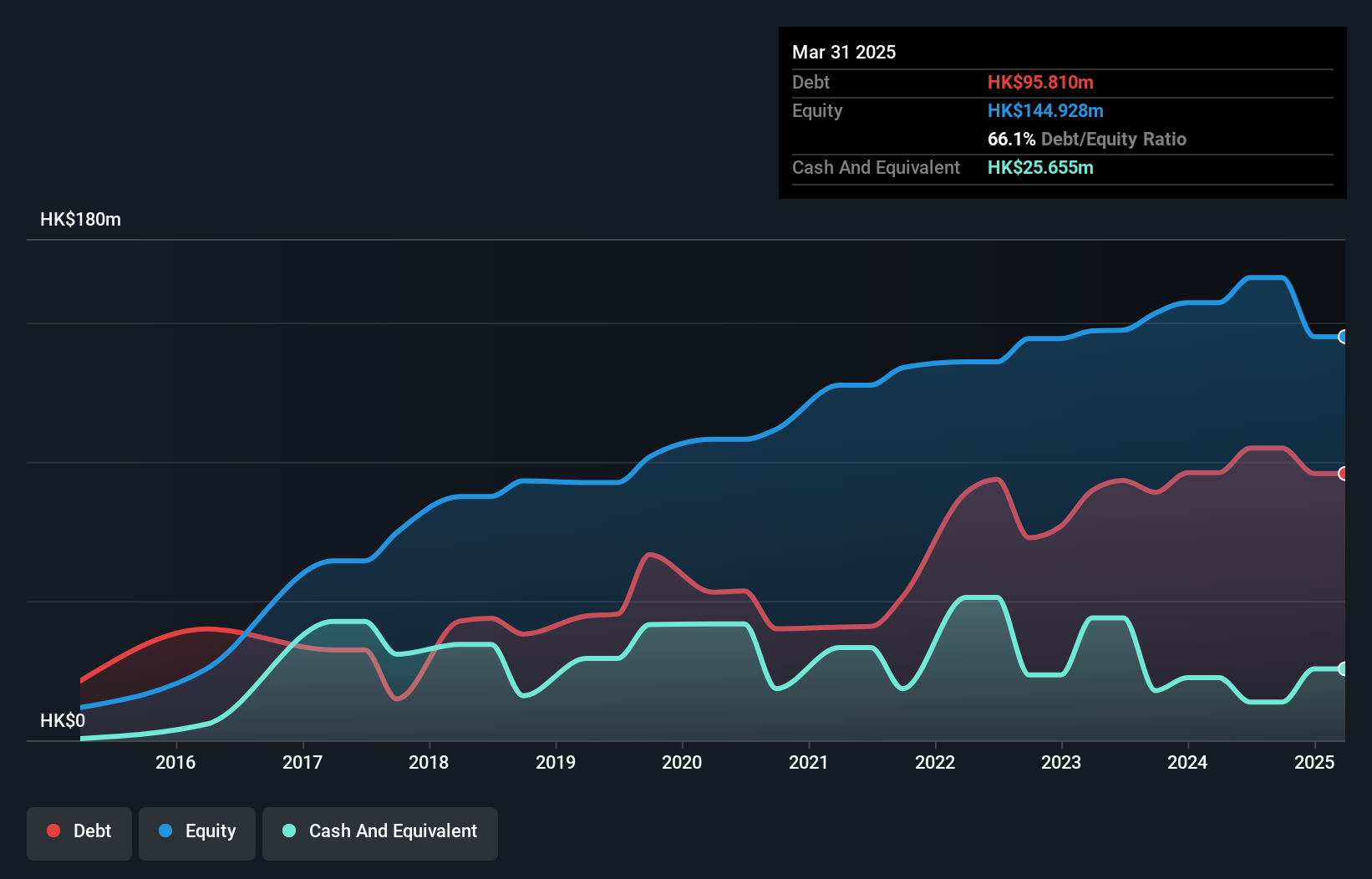
How Healthy Is Chi Ho Development Holdings' Balance Sheet?
The latest balance sheet data shows that Chi Ho Development Holdings had liabilities of HK$233.6m due within a year, and liabilities of HK$797.0k falling due after that. On the other hand, it had cash of HK$25.7m and HK$248.8m worth of receivables due within a year. So it can boast HK$40.0m more liquid assets than total liabilities.
This surplus strongly suggests that Chi Ho Development Holdings has a rock-solid balance sheet (and the debt is of no concern whatsoever). On this view, lenders should feel as safe as the beloved of a black-belt karate master.
Check out our latest analysis for Chi Ho Development Holdings
We measure a company's debt load relative to its earnings power by looking at its net debt divided by its earnings before interest, tax, depreciation, and amortization (EBITDA) and by calculating how easily its earnings before interest and tax (EBIT) cover its interest expense (interest cover). Thus we consider debt relative to earnings both with and without depreciation and amortization expenses.
Chi Ho Development Holdings has a rather high debt to EBITDA ratio of 9.5 which suggests a meaningful debt load. However, its interest coverage of 2.9 is reasonably strong, which is a good sign. Even worse, Chi Ho Development Holdings saw its EBIT tank 60% over the last 12 months. If earnings keep going like that over the long term, it has a snowball's chance in hell of paying off that debt. When analysing debt levels, the balance sheet is the obvious place to start. But you can't view debt in total isolation; since Chi Ho Development Holdings will need earnings to service that debt. So if you're keen to discover more about its earnings, it might be worth checking out this graph of its long term earnings trend.
Finally, a business needs free cash flow to pay off debt; accounting profits just don't cut it. So the logical step is to look at the proportion of that EBIT that is matched by actual free cash flow. Over the last three years, Chi Ho Development Holdings actually produced more free cash flow than EBIT. There's nothing better than incoming cash when it comes to staying in your lenders' good graces.
Our View
Happily, Chi Ho Development Holdings's impressive conversion of EBIT to free cash flow implies it has the upper hand on its debt. But we must concede we find its EBIT growth rate has the opposite effect. All these things considered, it appears that Chi Ho Development Holdings can comfortably handle its current debt levels. On the plus side, this leverage can boost shareholder returns, but the potential downside is more risk of loss, so it's worth monitoring the balance sheet. When analysing debt levels, the balance sheet is the obvious place to start. However, not all investment risk resides within the balance sheet - far from it. These risks can be hard to spot. Every company has them, and we've spotted 3 warning signs for Chi Ho Development Holdings you should know about.
At the end of the day, it's often better to focus on companies that are free from net debt. You can access our special list of such companies (all with a track record of profit growth). It's free.
Have feedback on this article? Concerned about the content? Get in touch with us directly. Alternatively, email editorial-team (at) simplywallst.com.
This article by Simply Wall St is general in nature. We provide commentary based on historical data and analyst forecasts only using an unbiased methodology and our articles are not intended to be financial advice. It does not constitute a recommendation to buy or sell any stock, and does not take account of your objectives, or your financial situation. We aim to bring you long-term focused analysis driven by fundamental data. Note that our analysis may not factor in the latest price-sensitive company announcements or qualitative material. Simply Wall St has no position in any stocks mentioned.
Contact Us
Contact Number :+852 3852 8500Webull Securities Limited is licensed with the Securities and Futures Commission of Hong Kong (CE No. BNG700) for carrying out Type 1 License for Dealing in Securities, Type 2 License for Dealing in Futures Contracts and Type 4 License for Advising on Securities.

English