
Health Check: How Prudently Does Honbridge Holdings (HKG:8137) Use Debt?
Legendary fund manager Li Lu (who Charlie Munger backed) once said, 'The biggest investment risk is not the volatility of prices, but whether you will suffer a permanent loss of capital.' It's only natural to consider a company's balance sheet when you examine how risky it is, since debt is often involved when a business collapses. We can see that Honbridge Holdings Limited (HKG:8137) does use debt in its business. But should shareholders be worried about its use of debt?
When Is Debt Dangerous?
Generally speaking, debt only becomes a real problem when a company can't easily pay it off, either by raising capital or with its own cash flow. Ultimately, if the company can't fulfill its legal obligations to repay debt, shareholders could walk away with nothing. However, a more usual (but still expensive) situation is where a company must dilute shareholders at a cheap share price simply to get debt under control. Of course, the upside of debt is that it often represents cheap capital, especially when it replaces dilution in a company with the ability to reinvest at high rates of return. The first thing to do when considering how much debt a business uses is to look at its cash and debt together.
What Is Honbridge Holdings's Net Debt?
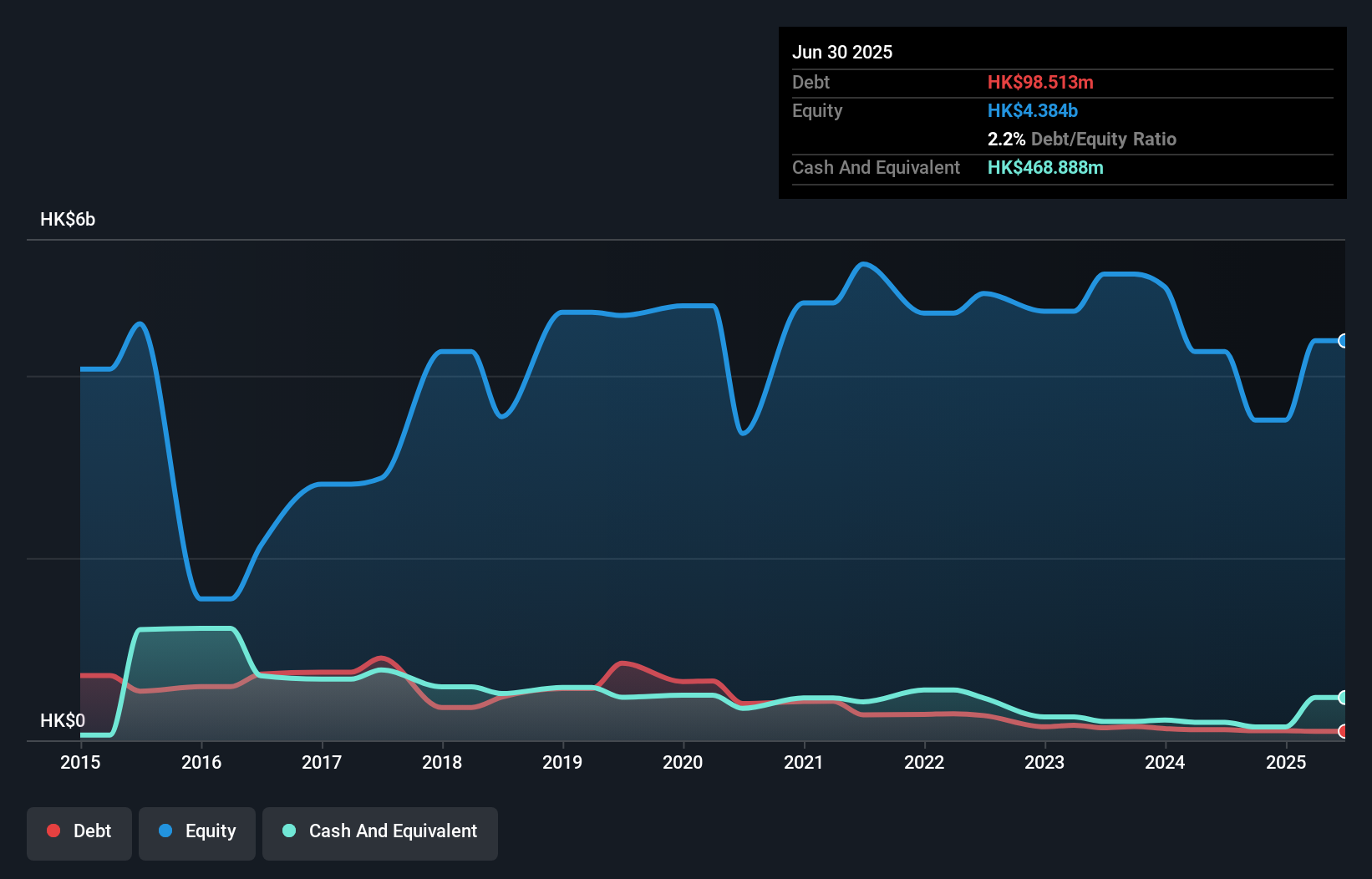
The image below, which you can click on for greater detail, shows that Honbridge Holdings had debt of HK$98.5m at the end of June 2025, a reduction from HK$116.1m over a year. However, its balance sheet shows it holds HK$468.9m in cash, so it actually has HK$370.4m net cash.
How Healthy Is Honbridge Holdings' Balance Sheet?
According to the last reported balance sheet, Honbridge Holdings had liabilities of HK$128.5m due within 12 months, and liabilities of HK$2.27b due beyond 12 months. Offsetting this, it had HK$468.9m in cash and HK$10.2m in receivables that were due within 12 months. So its liabilities total HK$1.92b more than the combination of its cash and short-term receivables.
This deficit isn't so bad because Honbridge Holdings is worth HK$6.96b, and thus could probably raise enough capital to shore up its balance sheet, if the need arose. But it's clear that we should definitely closely examine whether it can manage its debt without dilution. While it does have liabilities worth noting, Honbridge Holdings also has more cash than debt, so we're pretty confident it can manage its debt safely. When analysing debt levels, the balance sheet is the obvious place to start. But you can't view debt in total isolation; since Honbridge Holdings will need earnings to service that debt. So when considering debt, it's definitely worth looking at the earnings trend. Click here for an interactive snapshot.
View our latest analysis for Honbridge Holdings
Over 12 months, Honbridge Holdings made a loss at the EBIT level, and saw its revenue drop to HK$96m, which is a fall of 30%. That makes us nervous, to say the least.
So How Risky Is Honbridge Holdings?
We have no doubt that loss making companies are, in general, riskier than profitable ones. And we do note that Honbridge Holdings had an earnings before interest and tax (EBIT) loss, over the last year. And over the same period it saw negative free cash outflow of HK$87m and booked a HK$409m accounting loss. But the saving grace is the HK$370.4m on the balance sheet. That means it could keep spending at its current rate for more than two years. Overall, we'd say the stock is a bit risky, and we're usually very cautious until we see positive free cash flow. The balance sheet is clearly the area to focus on when you are analysing debt. But ultimately, every company can contain risks that exist outside of the balance sheet. We've identified 2 warning signs with Honbridge Holdings , and understanding them should be part of your investment process.
Of course, if you're the type of investor who prefers buying stocks without the burden of debt, then don't hesitate to discover our exclusive list of net cash growth stocks, today.
Have feedback on this article? Concerned about the content? Get in touch with us directly. Alternatively, email editorial-team (at) simplywallst.com.
This article by Simply Wall St is general in nature. We provide commentary based on historical data and analyst forecasts only using an unbiased methodology and our articles are not intended to be financial advice. It does not constitute a recommendation to buy or sell any stock, and does not take account of your objectives, or your financial situation. We aim to bring you long-term focused analysis driven by fundamental data. Note that our analysis may not factor in the latest price-sensitive company announcements or qualitative material. Simply Wall St has no position in any stocks mentioned.
Contact Us
Contact Number :+852 3852 8500Webull Securities Limited is licensed with the Securities and Futures Commission of Hong Kong (CE No. BNG700) for carrying out Type 1 License for Dealing in Securities, Type 2 License for Dealing in Futures Contracts and Type 4 License for Advising on Securities.

English