
Investors Could Be Concerned With Diwang Industrial Holdings' (HKG:1950) Returns On Capital
Did you know there are some financial metrics that can provide clues of a potential multi-bagger? Amongst other things, we'll want to see two things; firstly, a growing return on capital employed (ROCE) and secondly, an expansion in the company's amount of capital employed. Basically this means that a company has profitable initiatives that it can continue to reinvest in, which is a trait of a compounding machine. Although, when we looked at Diwang Industrial Holdings (HKG:1950), it didn't seem to tick all of these boxes.
Understanding Return On Capital Employed (ROCE)
For those that aren't sure what ROCE is, it measures the amount of pre-tax profits a company can generate from the capital employed in its business. The formula for this calculation on Diwang Industrial Holdings is:
Return on Capital Employed = Earnings Before Interest and Tax (EBIT) ÷ (Total Assets - Current Liabilities)
0.038 = CN¥27m ÷ (CN¥923m - CN¥213m) (Based on the trailing twelve months to June 2025).
So, Diwang Industrial Holdings has an ROCE of 3.8%. Ultimately, that's a low return and it under-performs the Chemicals industry average of 8.5%.
See our latest analysis for Diwang Industrial Holdings
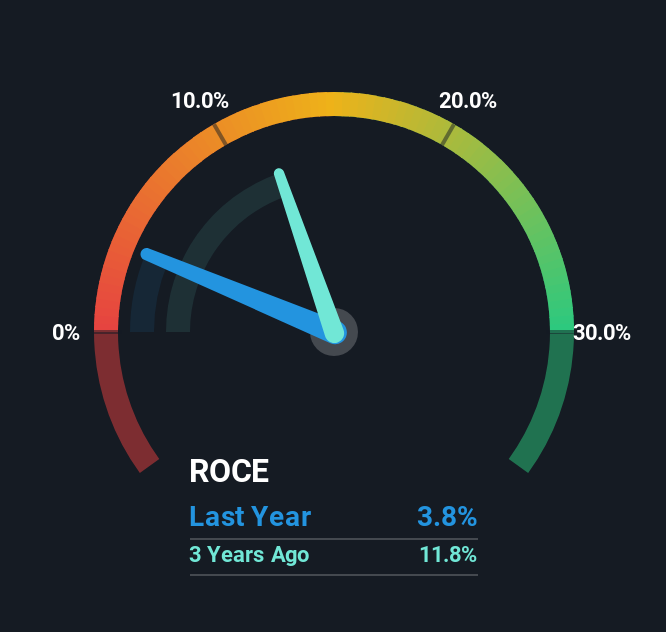
While the past is not representative of the future, it can be helpful to know how a company has performed historically, which is why we have this chart above. If you're interested in investigating Diwang Industrial Holdings' past further, check out this free graph covering Diwang Industrial Holdings' past earnings, revenue and cash flow.
So How Is Diwang Industrial Holdings' ROCE Trending?
On the surface, the trend of ROCE at Diwang Industrial Holdings doesn't inspire confidence. Over the last five years, returns on capital have decreased to 3.8% from 11% five years ago. Given the business is employing more capital while revenue has slipped, this is a bit concerning. If this were to continue, you might be looking at a company that is trying to reinvest for growth but is actually losing market share since sales haven't increased.
On a side note, Diwang Industrial Holdings' current liabilities have increased over the last five years to 23% of total assets, effectively distorting the ROCE to some degree. Without this increase, it's likely that ROCE would be even lower than 3.8%. Keep an eye on this ratio, because the business could encounter some new risks if this metric gets too high.
The Key Takeaway
From the above analysis, we find it rather worrisome that returns on capital and sales for Diwang Industrial Holdings have fallen, meanwhile the business is employing more capital than it was five years ago. We expect this has contributed to the stock plummeting 94% during the last five years. That being the case, unless the underlying trends revert to a more positive trajectory, we'd consider looking elsewhere.
Since virtually every company faces some risks, it's worth knowing what they are, and we've spotted 2 warning signs for Diwang Industrial Holdings (of which 1 shouldn't be ignored!) that you should know about.
If you want to search for solid companies with great earnings, check out this free list of companies with good balance sheets and impressive returns on equity.
Have feedback on this article? Concerned about the content? Get in touch with us directly. Alternatively, email editorial-team (at) simplywallst.com.
This article by Simply Wall St is general in nature. We provide commentary based on historical data and analyst forecasts only using an unbiased methodology and our articles are not intended to be financial advice. It does not constitute a recommendation to buy or sell any stock, and does not take account of your objectives, or your financial situation. We aim to bring you long-term focused analysis driven by fundamental data. Note that our analysis may not factor in the latest price-sensitive company announcements or qualitative material. Simply Wall St has no position in any stocks mentioned.
Contact Us
Contact Number :+852 3852 8500Webull Securities Limited is licensed with the Securities and Futures Commission of Hong Kong (CE No. BNG700) for carrying out Type 1 License for Dealing in Securities, Type 2 License for Dealing in Futures Contracts and Type 4 License for Advising on Securities.

English