
10 No-Brainer Stocks to Buy as Long as the Strait of Hormuz Is Closed
Key Points
Oil, LNG, refining, shipping, and fertilizer companies could benefit from ongoing disruptions.
U.S.-based producers and exporters are among those positioned to outperform due to supply chain shifts.
With the conflict in the Persian Gulf still ongoing, it's a good idea to buy some protection for a portfolio in case of an extended conflict, or even a relatively short one that results in lasting structural damage to the economic activity that preceded it.
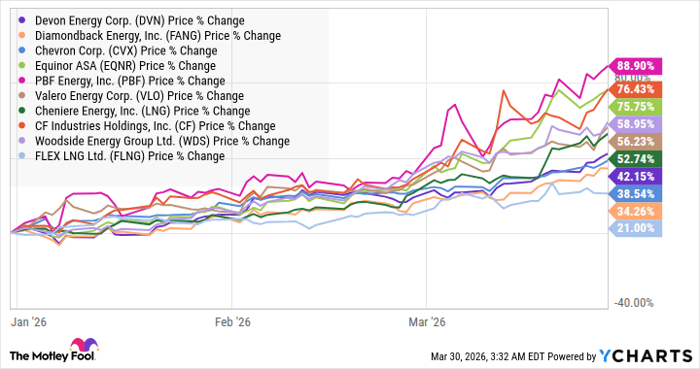
Following that line of thought, here's a whistle-stop tour through 10 stocks that can help investors in the current environment.
Will AI create the world's first trillionaire? Our team just released a report on the one little-known company, called an "Indispensable Monopoly" providing the critical technology Nvidia and Intel both need. Continue »
Three oil stocks to benefit if the price of oil spikes even higher
It's hard not to come across as Captain Obvious here, but oil and gas exploration and production companies are a good place to start, particularly those operating in the U.S., such as Permian Basin-focused Devon Energy (NYSE: DVN) and Diamondback Energy (NASDAQ: FANG). Those two companies are not only attractive as a tactical way to manage the risk of an oil price spike; they also look like a great value based on the price of oil before the conflict.
The third is integrated major Chevron (NYSE: CVX). Its upstream operations (exploration and production) benefit from a higher price of oil, and its downstream operations (refining) are also benefiting from the widening in the crack spread (difference between crude oil price and refined product price) caused by the difficulty Asian refiners are having obtaining crude oil and the lack of refined product.
Petroleum product refiners
Speaking of the crack spread, the most widely followed one is the 3-2-1 spread (the spread between the cost of three barrels of crude and two barrels of gasoline plus one barrel of diesel), and it's blown up to just over $54 from less than $20 at the start of the year.
That's great news for refiners like Valero Energy (NYSE: VLO) and PBF Energy (NYSE: PBF), who source crude from the U.S. regardless of its price. The latter is more of a pure-play refiner (Valero also has a renewable diesel business and ethanol operations), and PBF has outperformed the market. These stocks are likely to outperform as long as the crack spread remains wide and there's no demand destruction for transportation products (gasoline, etc.) caused by high prices.
Don't forget liquefied natural gas (LNG)
According to the International Energy Agency (IEA), 34% of global crude oil trade passes through the Strait of Hormuz, and 20% of global LNG trade does too. Almost 90% of LNG volume through the Strait goes to Asia, and the rest to Europe. LNG could also take longer to recover than oil, even if the Strait is opened, particularly if the world's largest LNG export facility, Ras Laffan in Qatar, continues to suffer damage.
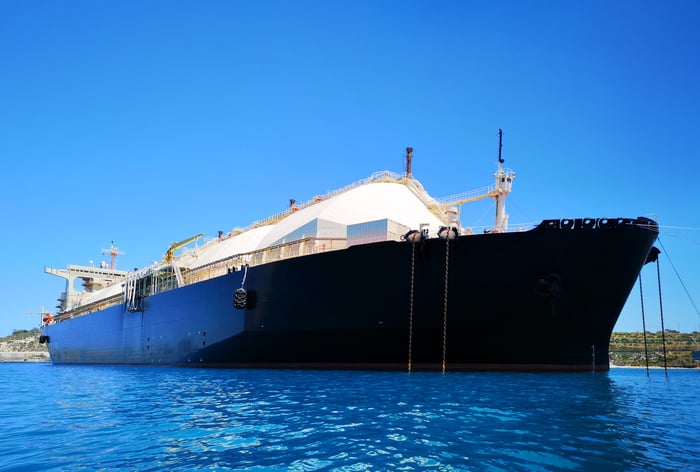
Image source: Getty Images.
Three companies that can help fill the LNG supply gap created by the Strait blockade. Woodside Energy Group (NYSE: WDS) is an Australian LNG producer (with a 4.5% dividend yield and a U.S. listing) and is ideally positioned to supply LNG to Asian markets.
Cheniere Energy (NYSE: LNG) is already the largest U.S. LNG exporter, and although it's operating at maximum capacity now, it's in a multiyear process of expanding its export capacity with a new LNG train (a unit to liquefy natural gas) expected to ramp production imminently.
The third LNG (and also crude oil) play is Norway's Equinor (NYSE: EQNR), a leading LNG exporter with assets off Norway's coast. It will help fill the gap for European countries previously supplied with LNG through the Strait.
Shipping and fertilizers
Speaking of Norway and LNG, shipping company Flex LNG (NYSE: FLNG) is also well positioned to benefit from higher LNG shipping rates and demand for its modern, fuel-efficient fleet. If LNG can't reach Asia through the Strait, it's likely to be shipped over much longer distances – great news for shipping companies, daily rates, and fleet utilization.
Finally, it isn't just crude oil, LNG, and refined petroleum products that go through the Strait. About a third of global seaborne fertilizer flows through the Strait, according to the United Nations. Gas is the major component of fertilizer, and the lack of gas and fertilizer through the Strait means that a U.S.-focused ferrilizer producer like CF Industries (NYSE: CF) will benefit from its manufacturing facilities in the West as well as its supply of gas from the U.S.
Lee Samaha has no position in any of the stocks mentioned. The Motley Fool has positions in and recommends Cheniere Energy and Chevron. The Motley Fool recommends Equinor Asa. The Motley Fool has a disclosure policy.
Contact Us
Contact Number :+852 3852 8500Webull Securities Limited is licensed with the Securities and Futures Commission of Hong Kong (CE No. BNG700) for carrying out Type 1 License for Dealing in Securities, Type 2 License for Dealing in Futures Contracts and Type 4 License for Advising on Securities.

English