
Is It Time To Reassess Onsemi (ON) After A 54% One Year Share Price Jump
- If you are wondering whether ON Semiconductor's current share price reflects its true worth, you are not alone. This article walks through what the recent numbers might be telling you about value.
- Over the past year the stock has returned 54.0%, while shorter term moves show a 0.7% decline over 7 days, a 6.9% decline over 30 days and a 9.2% gain year to date from a last close of US$61.92.
- Recent headlines have focused on ON Semiconductor's role in key chip supply chains and ongoing interest in semiconductor names connected to power management and automotive demand. These themes help frame why the share price has moved sharply over the last year, even with some short term pullbacks.
- ON Semiconductor currently holds a 4 out of 6 valuation score. This will be unpacked using several common valuation approaches. Later, the article will look at a broader framework that can help you think about value in an even more complete way.
Find out why ON Semiconductor's 54.0% return over the last year is lagging behind its peers.
Approach 1: ON Semiconductor Discounted Cash Flow (DCF) Analysis
A Discounted Cash Flow, or DCF, model looks at the cash ON Semiconductor is expected to generate in the future and discounts those projected amounts back to today, using a required rate of return, to estimate what the business might be worth right now.
For ON Semiconductor, the model uses a 2 Stage Free Cash Flow to Equity approach based on its last twelve months free cash flow of about US$1.04b and a series of projections out to 2035. Analyst estimates underpin the nearer term years, while Simply Wall St extrapolates further out, including a projected free cash flow of US$2.37b in 2030. Each of these future cash flows is discounted back to today and then summed.
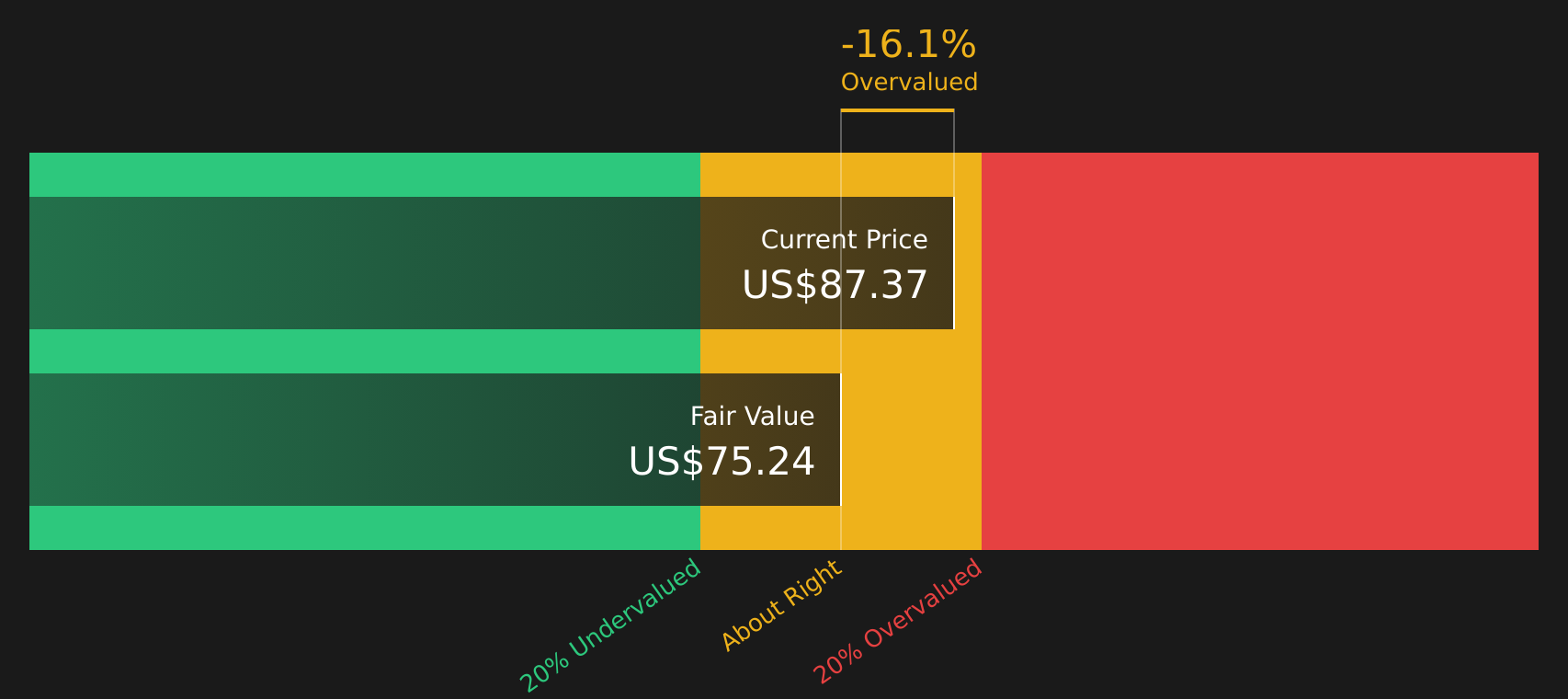
On this basis, the DCF output suggests an estimated intrinsic value of US$66.52 per share, compared with the recent share price of US$61.92. That implies the shares trade at roughly a 6.9% discount to this estimate, so the model points to the stock being slightly undervalued rather than significantly mispriced.
Result: ABOUT RIGHT
ON Semiconductor is fairly valued according to our Discounted Cash Flow (DCF), but this can change at a moment's notice. Track the value in your watchlist or portfolio and be alerted on when to act.
Approach 2: ON Semiconductor Price vs Sales
For profitable companies like ON Semiconductor, the price to sales, or P/S, multiple can be a useful cross check because it links the share price to the revenue the business generates, which is often less volatile than earnings for chipmakers.
In general, higher growth expectations and lower perceived risk can support a higher “normal” P/S multiple, while slower expected growth or higher risk tend to justify a lower one. So context matters when you look at any headline ratio.
ON Semiconductor currently trades on a P/S of 4.07x. That is below the Semiconductor industry average P/S of 5.67x and also below the peer group average of 12.12x. Simply Wall St’s Fair Ratio framework estimates what a company’s P/S “should” be based on factors such as earnings growth, profit margins, industry, market value and risk profile. This tends to be more tailored than a simple comparison with peers or the sector, which may have very different growth and risk characteristics.
For ON Semiconductor, the Fair Ratio is 4.25x versus the current 4.07x, a small gap that points to the shares trading close to this model based estimate of value.
Result: ABOUT RIGHT

P/S ratios tell one story, but what if the real opportunity lies elsewhere? Start investing in legacies, not executives. Discover our 20 top founder-led companies.
Upgrade Your Decision Making: Choose your ON Semiconductor Narrative
Earlier it was mentioned that there is an even better way to understand valuation. Narratives on Simply Wall St let you attach a clear story about ON Semiconductor to the numbers by linking your view of its future revenue, earnings and margins to a financial forecast, a Fair Value, and then an easy comparison with today’s share price. All of this sits inside the Community page where millions of investors share views that update automatically as new news or earnings arrive. One investor might focus on the more cautious US$56.00 Fair Value with revenue growing around 7.2% a year and a 15.4x P/E in 2029. Another might lean toward a more optimistic US$78.63 Fair Value with revenue growth around 10.1%, a 24.2% margin and an 18.8x future P/E. You can see both stories side by side to decide which one fits your own expectations and whether the current price feels high, low or about right.
For ON Semiconductor however we will make it really easy for you with previews of two leading ON Semiconductor Narratives:
Fair Value: US$68.20
Implied discount to Fair Value: 9.2%
Revenue growth assumption: 8.46%
- Focus on expanding EV and AI partnerships, silicon carbide and power solutions as key revenue and margin drivers.
- Uses portfolio streamlining, Fab Right and efficiency projects to support higher profitability and cash flow over time.
- Flags exposure to cyclical auto demand, underutilized manufacturing and geopolitical or competitive pressure as important risks.
Fair Value: US$56.00
Implied premium to Fair Value: 10.6%
Revenue growth assumption: 7.15%
- Highlights rising geopolitical, regulatory and supply chain localization costs that could weigh on margins.
- Assumes intense competition and potential overcapacity in power and silicon carbide products create revenue and margin uncertainty.
- Accepts that long term demand drivers in electrification and AI exist, but treats them as not fully offsetting cost and execution risks at this Fair Value.
Do you think there's more to the story for ON Semiconductor? Head over to our Community to see what others are saying!

This article by Simply Wall St is general in nature. We provide commentary based on historical data and analyst forecasts only using an unbiased methodology and our articles are not intended to be financial advice. It does not constitute a recommendation to buy or sell any stock, and does not take account of your objectives, or your financial situation. We aim to bring you long-term focused analysis driven by fundamental data. Note that our analysis may not factor in the latest price-sensitive company announcements or qualitative material. Simply Wall St has no position in any stocks mentioned.
Have feedback on this article? Concerned about the content? Get in touch with us directly. Alternatively, email editorial-team@simplywallst.com
Contact Us
Contact Number :+852 3852 8500Webull Securities Limited is licensed with the Securities and Futures Commission of Hong Kong (CE No. BNG700) for carrying out Type 1 License for Dealing in Securities, Type 2 License for Dealing in Futures Contracts and Type 4 License for Advising on Securities.

English