
Amazon is Considering a $9 Billion Deal to Acquire Satellite Communications Company Globalstar. Here's Why Amazon, Apple, and Tesla Investors Should Pay Attention.
Key Points
Amazon is reportedly pursuing a deal to acquire satellite telecom company Globalstar.
Amazon's own efforts to launch a satellite system have faced challenges, and it risks missing an important regulatory deadline.
Competition in the "space" is ramping up.
The space race is heating up in recent days, and in more ways than one. The launch of Artemis II this week to fly around the moon has captured the imagination of Wall Street and Main Street alike, and investors are taking a fresh look at the intersection of stocks and space.
Further stoking this interest is word that Amazon (NASDAQ: AMZN) may be looking to expand its satellite business. The company is in discussions to scoop up $9 billion satellite telecommunications company Globalstar (NASDAQ: GSAT), according to a report that first appeared in the Financial Times.
Will AI create the world's first trillionaire? Our team just released a report on the one little-known company, called an "Indispensable Monopoly" providing the critical technology Nvidia and Intel both need. Continue »
If the parties were to reach an agreement, it could have implications that stretch far beyond Amazon and Globalstar and could have ramifications for Apple and Tesla. Read on to find out why.
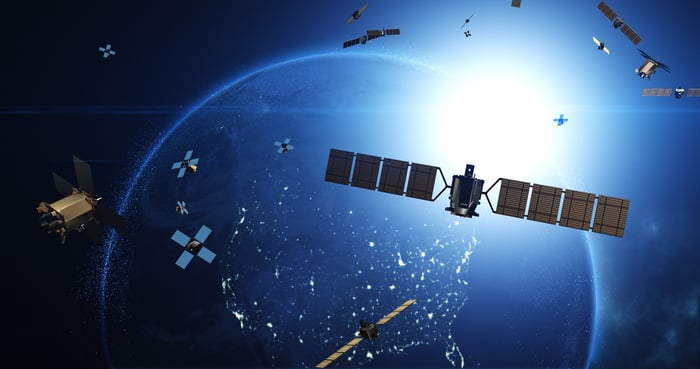
Image source: Getty Images.
Looking to the stars
Amazon has been looking to the stars for some time now. Founder and former CEO Jeff Bezos owns rocket company Blue Origin and was instrumental in the launch of Project Kuiper -- now called Amazon Leo. The goal of the project is to launch a constellation of more than 3,000 satellites into low Earth orbit (LEO) -- at a distance of about 380 miles -- to blanket the planet with "reliable broadband coverage."
Over the past year, Amazon has launched roughly 200 LEO satellites into space, aiming to eventually grow the fleet to 7,700 and debut its commercial internet service in late 2026. Unfortunately, the company has struggled with delays due to rocket shortages, manufacturing disruptions, the grounding or failure of existing launch vehicles, and the limited availability of launch platforms.
Earlier this year, Amazon was forced to petition the U.S. Federal Communications Commission (FCC) for an extension, saying it might not be able to launch 1,600 LEO satellites before the July deadline.
For its part, Globalstar currently operates 24 LEO satellites, with plans to expand to 32 later this year. If Amazon were to acquire Globalstar, it would immediately bolster the company's satellite operations.
Tesla CEO Elon Musk is already a major player in the space race, as founder and CEO of SpaceX, which has reportedly filed for its initial public offering (IPO) later this year. SpaceX, through its Starlink service, has already launched more than 10,000 satellites and offers internet service to more than 9 million users -- giving the company a sizable lead in the space.
The fly in the ointment
Any potential deal will be complicated by Apple. The iPhone maker invested $1.5 billion in Globalstar in 2024, giving it a 20% equity stake in the company. As part of the deal, Globalstar agreed to allocated 85% of the company's network capacity to Apple to facilitate satellite-powered texting when users are outside the coverage area. That ownership stake means that Apple will be a party to and included in the acquisition discussions.
It's important to keep in mind that neither Amazon nor Globalstar has confirmed the talks, and even if discussions are taking place, they may not reach an agreement.
Investors should keep an eye out for further developments or any official announcement.
Danny Vena, CPA has positions in Amazon, Apple, and Tesla. The Motley Fool has positions in and recommends Amazon, Apple, and Tesla and is short shares of Apple. The Motley Fool has a disclosure policy.
Contact Us
Contact Number :+852 3852 8500Webull Securities Limited is licensed with the Securities and Futures Commission of Hong Kong (CE No. BNG700) for carrying out Type 1 License for Dealing in Securities, Type 2 License for Dealing in Futures Contracts and Type 4 License for Advising on Securities.

English