
The eVTOL Era is Beginning With Uber and Joby Aviation: What Investors Need to Know
Key Points
Joby Aviation plans to lead Western eVTOL launches with Uber in Dubai.
Business models and timelines differ widely among eVTOL companies.
eVTOL stocks are volatile but offer long-term growth potential.
Joby Aviation (NYSE: JOBY) is the front-runner among Western companies to launch commercial electric vertical takeoff and landing (eVTOL) operations in Dubai this year, in partnership with its investor, Uber Technologies. Its rival, Archer Aviation (NYSE: ACHR), also plans to launch in Abu Dhabi in 2026.
Although both events are at risk amid conflict in the region, they still symbolize the beginning of a new era of eVTOL travel. Here's what you need to know about investing in the sector.
Will AI create the world's first trillionaire? Our team just released a report on the one little-known company, called an "Indispensable Monopoly" providing the critical technology Nvidia and Intel both need. Continue »
The eVTOL market is highly competitive
While Joby and Archer capture most of the attention due to their progress toward Federal Aviation Administration (FAA) certification and upcoming commercial launches, there are plenty of ways to invest in the sector. For example, the U.K.'s Vertical Aerospace (NYSE: EVTL) is seeking certification from the U.K.'s Civil Aviation Authority and European Union Aviation Safety Agency (EASA) in 2028, with FAA certification to follow.

Image source: Joby Aviation.
China's eHang (NASDAQ: EH) has recently launched commercial services in China. Beta Technologies (NYSE: BETA) is developing an electric conventional takeoff and landing (eCTOL) system that will use standard runways and then an eVTOL, both for commercial use, including for cargo customers like UPS.
Interestingly, Beta is selling propulsion systems to Brazil's Embraer-backed Eve (NYSE: EVEX). Meanwhile, Embraer isn't the only major aircraft manufacturer active in the eVTOL niche, as Boeing is investing heavily in its subsidiary, Wisk, an eVTOL company focused on autonomous eVTOL.
Business models differ dramatically
This is where it gets a bit complicated, and also fascinating, because each company appears to have its own business model. Joby is probably the most ambitious because it's pursuing a vertically integrated transportation-as-a-service (TaaS) model. Not only is it developing its own technology, with manufacturing help from key investor Toyota, but it's also creating its own transportation services company through its partnership with Uber.
As such, it's hugely impressive that Joby is leading the certification race and is ahead of rivals like Archer and Vertical, which are primarily original equipment manufacturers (OEMs) relying on established aerospace companies (Honeywell, etc.) for component supplies, such as propulsion systems. In theory, Archer and Vertical should be ahead due to these relationships, but Joby's go-it-alone strategy appears to be working.

Image source: Getty Images.
That said, it may face intense competition from Boeing's Wisk in a few years. Rather surprisingly, as Boeing is an OEM, it's also developing Wisk as a TaaS company. Still, there's a difference: Wisk aims to cut the cost of the pilot out of its services by developing only autonomous eVTOLs.
Beta is focused on being an OEM company and has customers such as UPS, United Therapeutics, and Air New Zealand. However, it also plans to generate long-term revenue from aftermarket services on its eCTOL and eVTOL and, notably, its electric charging infrastructure, which is based on CCS-1 protocol (making it highly compatible) and is also for use for "all electric aircraft operators," according to its Securities and Exchange Commission filings.
Finally, Embraer's Eve is a fascinating eVTOL company, as its model involves serving as an OEM and leveraging key partners' technologies (for example, Beta, Thales, and BAE Systems), as well as developing an Urban Air Traffic Management system, Vector, which could become the industry standard. In addition, it aims to leverage Embraer's global operations to offer aftermarket maintenance, repair, and overhaul (MRO) services to customers.
Which eVTOL stocks to buy?
Clearly, this is a nascent, highly competitive industry, and as you can see, eVTOL stocks have sharply sold off this year. The long-term potential, however, is obvious. Joby probably offers the most upside potential due to its TaaS model and first-mover advantage, but it may need funding to support its growth plans.
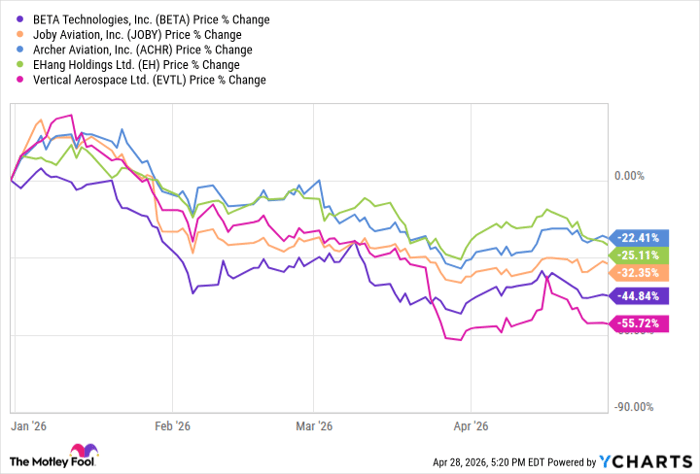
Beta probably did its initial public offering at the perfect time (November 2025), and the Wall Street average estimate suggests it will end 2026 with $971 million in net cash and no need to raise capital until it starts generating cash in 2030. Moreover, the combination of reliance on the cargo/logistics market and the opportunity to earn early revenue via the Eve deal and OEM sales makes it an attractive stock for eVTOL investors.
Lee Samaha has no position in any of the stocks mentioned. The Motley Fool has positions in and recommends Boeing, Honeywell International, Uber Technologies, United Parcel Service, and United Therapeutics. The Motley Fool recommends BAE Systems and Embraer. The Motley Fool has a disclosure policy.
Contact Us
Contact Number :+852 3852 8500Webull Securities Limited is licensed with the Securities and Futures Commission of Hong Kong (CE No. BNG700) for carrying out Type 1 License for Dealing in Securities, Type 2 License for Dealing in Futures Contracts and Type 4 License for Advising on Securities.

English