
Options Traders Are Betting on Increasingly Diverging Paths for Intel Stock in 2026
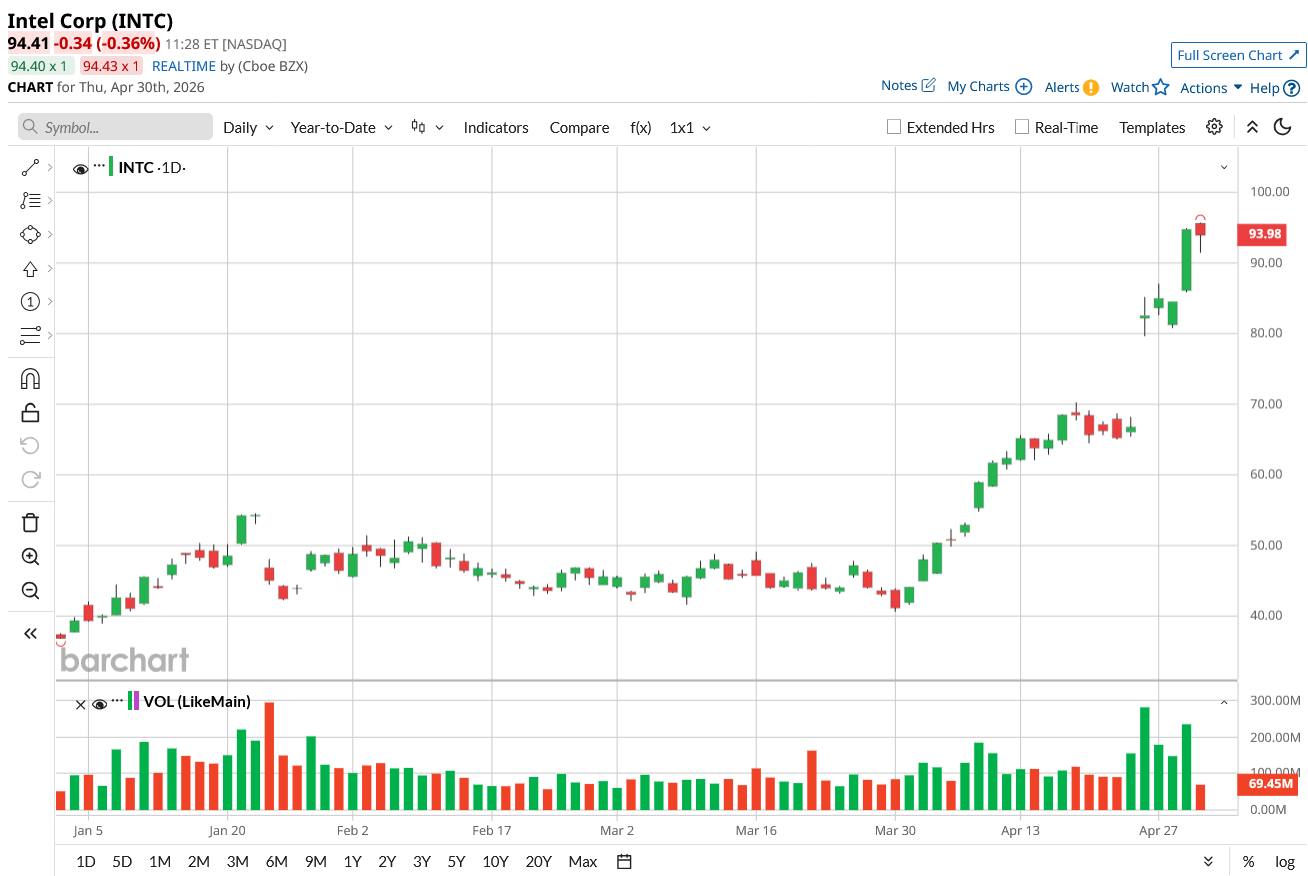
Intel (INTC) has staged one of the most dramatic runs in the semiconductor space this year. Shares have more than doubled year-to-date (YTD), reclaiming levels not seen in decades and forcing investors to reassess both the company’s long-term prospects and its near-term risk profile.
Whenever a company experiences such a rapid repricing, the debate tends to shift from whether the story has improved to how much of that improvement is already reflected in the stock. That tension is now clearly visible in the options market. Based on current pricing, the expected move in Intel shares through July 2026 now exceeds 23% in either direction.
So what exactly is the options market telling us about Intel’s path into 2026? And are traders leaning bullish, bearish, or simply preparing for volatility? Let’s take a closer look.
About Intel Stock
Intel Corporation is a leading global designer and manufacturer of semiconductor chips and computing components. As a cornerstone of the tech industry, Intel pioneered the x86 microprocessor architecture and remains a dominant supplier of CPUs for personal computers, servers, and data centers, as well as AI, networking, and edge computing devices. The company is currently focused on AI, 5G network transformation, and revitalizing its chip manufacturing business through Intel Foundry. It has a market cap of $424.8 billion.
Shares of the chipmaker have rallied 151% on a YTD basis, reflecting a marked improvement in the company’s outlook. It’s beginning to gain traction in AI, driven by surging demand for central processing units (CPUs). Moreover, several developments helped drive the stock’s impressive rally. It spent $14 billion to repurchase half of an Irish plant it had previously sold to Apollo Global Management, teamed up with Elon Musk on the Terafab semiconductor manufacturing project, and secured a commitment from Alphabet’s (GOOG) (GOOGL) Google to deploy its processors.
What the Options Market Tells Us About Intel Stock’s Path Forward
There’s no doubt that Intel’s earnings report last week impressed everyone on Wall Street. The company reported Q1 results that blew past Wall Street estimates and delivered a blockbuster Q2 sales forecast, sending its stock soaring more than 23% last Friday. As a result, Intel’s stock hit a couple of milestones, posting its biggest single-day percentage gain since October 1987 and reaching its first record high since August 2000.
After such a stellar run, investors may start asking whether Intel stock has any further upside this year. And one way to approach that question is by looking to the options market for clues. I’m talking about determining a stock’s expected price move using a long straddle strategy. Previously, I had to run all the calculations myself, but now Barchart has a beautiful page that provides the results instantly:
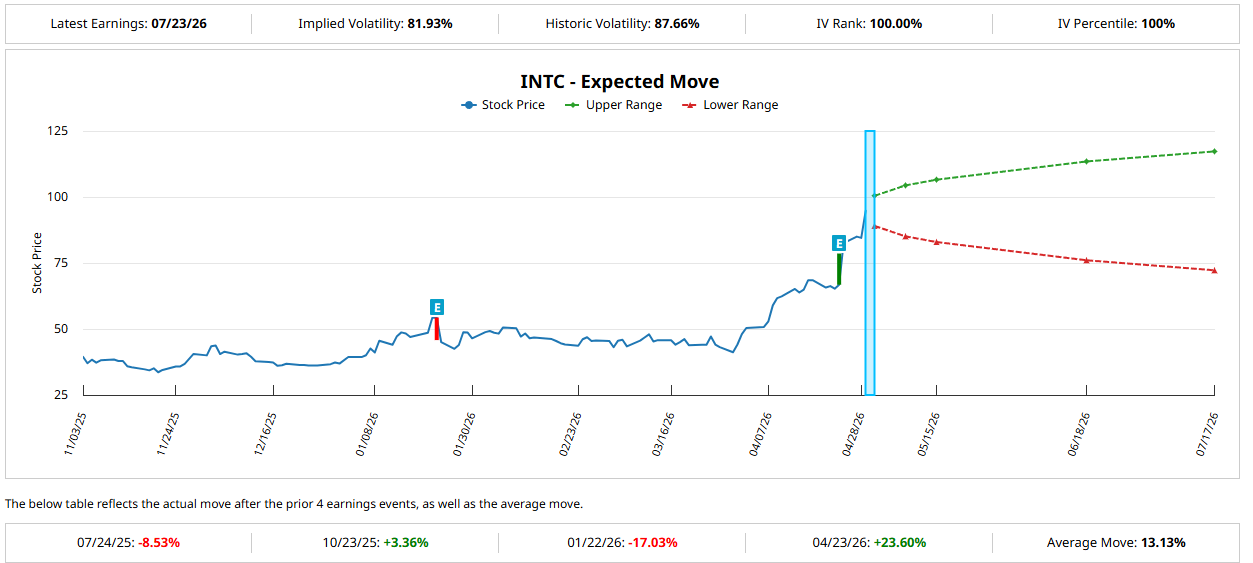
As shown above, the options market implies that INTC stock could move roughly 24% higher or lower by the July expiration, based on current options pricing. Note that this expected move is calculated based on 85% of the value of the at-the-money straddle. That would place the stock in a trading range of $72.23 to $117.28.
At this point, let’s try to determine which scenario is more likely for Intel stock—hitting the lower or the upper bound of the trading range identified in the previous step. Once again, the options market can help us with this. I am going to compare the open interest in calls and puts at the strike price closest to the stock’s current price to gauge sentiment around INTC stock. That said, there are about 61 times more open calls than open puts at the $95.00 strike price, with 6,865 open calls compared to just 113 open puts. This points to very strong bullish sentiment in the options market toward INTC stock. And open calls continue to exceed open puts all the way up to the $120 strike price. This suggests that INTC stock currently has a higher probability of reaching the upper end of the range rather than the lower bound.
While the options math was insightful, it’s equally important to examine the fundamental drivers that could push the stock toward either the upper or lower end of the range, so let’s take a closer look at those factors.
The Bull Case
There’s little doubt that Intel largely missed the first leg of the AI race, as it failed to develop a processor capable of competing with Nvidia’s (NVDA) flagship GPUs, and its advanced chip-fabrication business also fell behind rival Taiwan Semiconductor Manufacturing. (TSM). However, the next wave of the AI race is bringing Intel back into the game. As AI companies deployed large language models and other tools powered by autonomous AI agents, the central processing unit (CPU), a more traditional type of processor in which Intel specializes, has become a critical component.
“In recent months, we have seen clear signs that the CPU is reasserting itself as the indispensable foundation of the AI era,” CEO Lip-Bu Tan said on the company’s earnings call. AI servers need traditional CPUs to coordinate and manage overall system operations. While GPUs are the muscle, the CPU acts as the “brain.” Tan noted that the required CPU-to-GPU ratio has shifted to roughly one to four today, versus about one to eight in previous years. This shift is driving significant demand for Intel’s flagship Xeon server processors. “There is huge demand,” Tan said.
The Bear Case
Intel is, of course, not the only player in the CPU market, so competition is an issue investors should closely monitor. AMD (AMD) is Intel’s primary rival in the CPU market, and its products are far more competitive today than they were in the past. An even greater challenge comes from Arm (ARM), which is introducing a new alternative to the x86-based chips made by Intel and AMD. That said, if rivals continue to gain market share in the CPU space at Intel’s expense, the stock could face a reality check.
Another important factor to consider is valuation risk. The stock nearly doubled in April, leaving it trading at a forward non-GAAP P/E of 78.51x, even after a wave of upward earnings revisions. That compares with a forward P/E of 47.99x for rival Advanced Micro Devices and 25.56x for AI darling Nvidia. And over the past year, we’ve already seen how the market can punish AI-related stocks that trade at elevated valuations. With that, INTC stock could be vulnerable to a sharp pullback if the “AI scare trade” returns.
What Do Analysts Expect for INTC Stock?
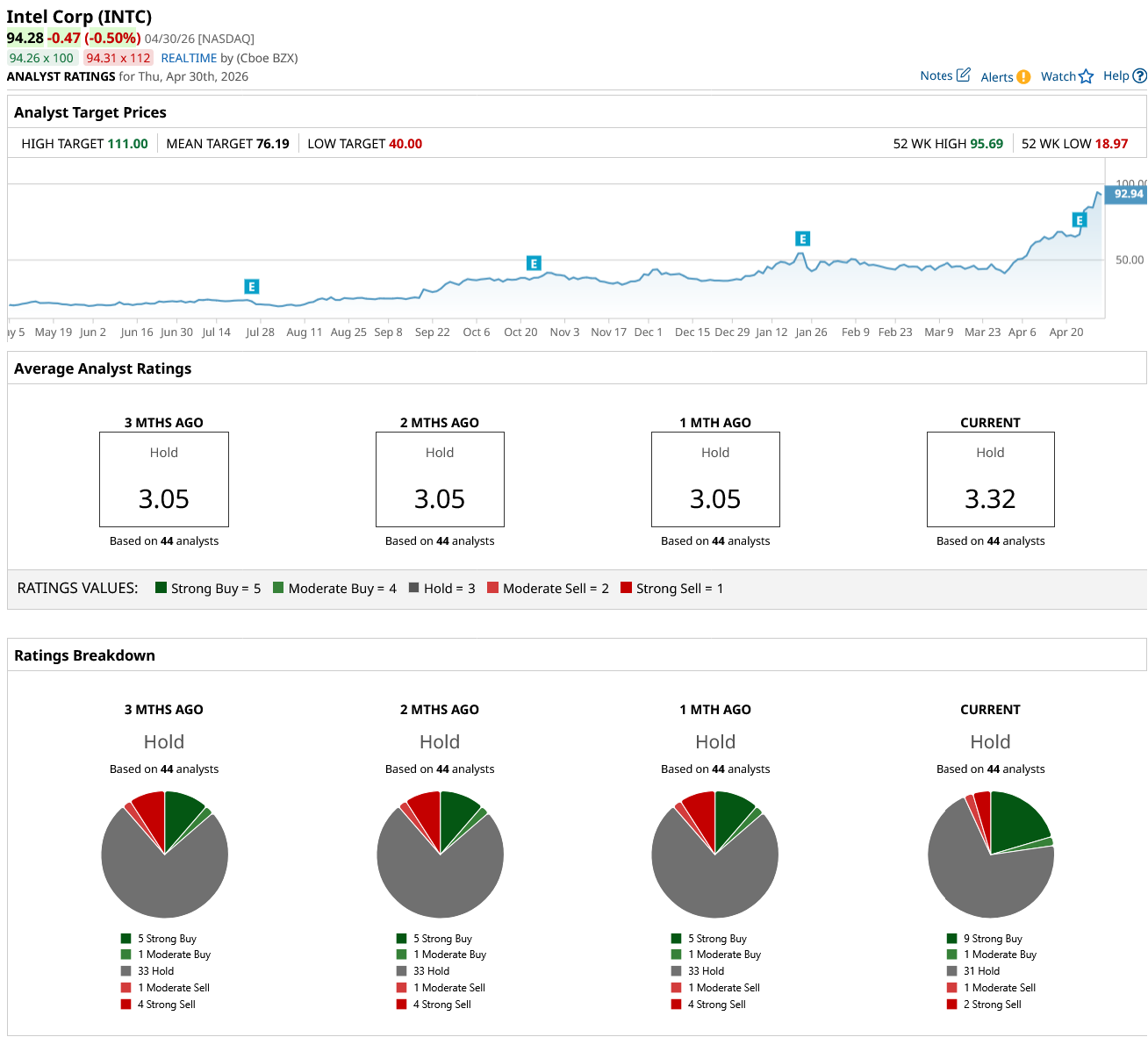
INTC stock has a consensus “Hold” rating. Among the 44 analysts covering the stock, nine rate it a “Strong Buy,” one assigns a “Moderate Buy” rating, 31 recommend holding, one suggests a “Moderate Sell,” and the remaining two issue a “Strong Sell” rating. Unsurprisingly, the stock trades above its mean price target of $76.19, but it still offers an 18% upside potential to the Street-high target of $111.
On the date of publication, Oleksandr Pylypenko did not have (either directly or indirectly) positions in any of the securities mentioned in this article. All information and data in this article is solely for informational purposes. For more information please view the Barchart Disclosure Policy here.
Contact Us
Contact Number :+852 3852 8500Webull Securities Limited is licensed with the Securities and Futures Commission of Hong Kong (CE No. BNG700) for carrying out Type 1 License for Dealing in Securities, Type 2 License for Dealing in Futures Contracts and Type 4 License for Advising on Securities.

English