
The AI Race Is Quietly Becoming a Race for Electricity, Not Chips
Key Points
The next supply-and-demand imbalance that limits the pace of AI infrastructure growth may be a shortage of baseload electricity to power it.
New power plants can take longer to build than new chip foundries.
This issue should benefit utility giant Constellation Energy and data center operator Applied Digital.
For the past three years, the artificial intelligence (AI) race has looked fairly straightforward. Companies such as OpenAI, Anthropic, and Alphabet have competed to build increasingly powerful large language models. Meanwhile, Nvidia has emerged as one of the biggest winners by supplying the powerful chips that enable those models.
But a new reality is emerging. The winners in the next phase of the AI race may not be determined solely by which players have the best model or the fastest chip. It may be determined by which ones can secure enough electricity.
Will AI create the world's first trillionaire? Our team just released a report on the one little-known company, called an "Indispensable Monopoly" providing the critical technology Nvidia and Intel both need. Continue »
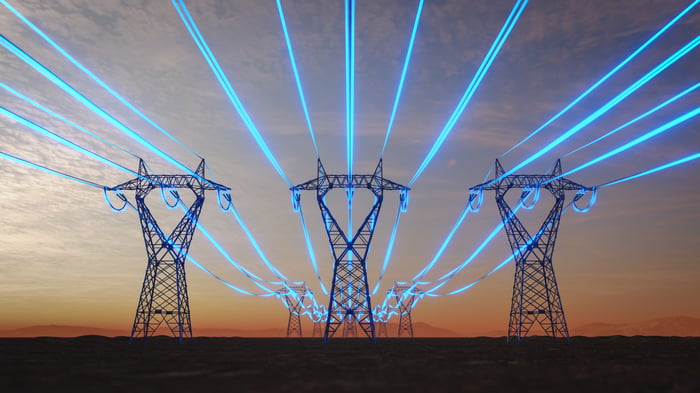
Image source: Getty Images.
AI needs more than chips
When investors think about AI infrastructure, they usually think about GPUs.
That makes sense. Those advanced chips remain the engines providing the key processing power for large language models and other AI applications. But every GPU requires a physical environment in which to operate.
Data centers must supply electricity, cooling, networking, and security. As AI systems become larger and more capable, those requirements become increasingly demanding. To put it into perspective, a single hyperscale AI data center can consume as much electricity as a small city. Future AI data centers could require even more.
The next bottleneck may be harder to solve
Right now, the growth rate for the AI industry is facing several bottlenecks relating to semiconductors, including GPUs and memory. But here's the thing: The semiconductor industry should eventually be able to bring the supply of those chips into line with demand by building more manufacturing capacity. Per chipmaker Intel, it can take about three or four years to build a new fab.
Power infrastructure is different. Developing new generation capacity, transmission lines, substations, and data center campuses can take many years. Utilities must navigate regulatory approvals, construction timelines, and significant capital investments.
In other words, power infrastructure cannot scale as quickly as the demand for AI computing. That mismatch is creating a new bottleneck. So technology companies are increasingly competing not only for GPUs but also for access to electricity and data center capacity. The AI race is gradually becoming a race for infrastructure.
Investors may be looking in the wrong place
So far, the market has largely rewarded the hardware companies that enabled the first phase of AI. Nvidia is the most obvious example, and Micron has recently taken center stage.
But transformative technologies often create multiple layers of winners. The internet created opportunities for software companies, cloud providers, network operators, and data center owners. Artificial intelligence could follow a similar path. Investors who focus exclusively on AI software and semiconductors may be overlooking another part of the ecosystem.
For instance, Constellation Energy (NASDAQ: CEG), the largest nuclear power operator in the United States, is set to benefit from the electricity bottleneck. Similarly, Applied Digital (NASDAQ: APLD), a company focused on developing AI data centers, already has contracted access to the electricity needed to run its AI data centers.
These companies providing power and electrified infrastructure could become just as important as the companies building AI itself.
The hidden story behind artificial intelligence
Many investors still view artificial intelligence primarily through the lens of software. That perspective made sense when AI was a niche technology used by a relatively small number of businesses.
Today, AI is becoming a foundational technology. Millions of users interact with AI systems every day. Companies are embedding AI into search engines, productivity software, customer service platforms, and business workflows. Every one of those interactions requires computing power. And every unit of computing power ultimately requires electricity. That simple fact may become one of the most important investment themes of the next decade.
What does it mean for investors?
The AI boom is often portrayed as a battle between technology giants and semiconductor companies. Those businesses will remain important.
But investors who focus exclusively on software and chips may miss a critical part of the story. Artificial intelligence is creating an enormous demand for physical infrastructure.
As AI models become larger and adoption continues to expand, access to power may become one of the industry's most important competitive advantages. The first phase of the AI boom belonged to chips. The next phase may belong to the companies that keep those chips running.
That's where investors should focus to find the next big winners.
Lawrence Nga has no position in any of the stocks mentioned. The Motley Fool has positions in and recommends Alphabet, Constellation Energy, Intel, Micron Technology, and Nvidia. The Motley Fool has a disclosure policy.
Contact Us
Contact Number :+852 3852 8500Webull Securities Limited is licensed with the Securities and Futures Commission of Hong Kong (CE No. BNG700) for carrying out Type 1 License for Dealing in Securities, Type 2 License for Dealing in Futures Contracts and Type 4 License for Advising on Securities.

English