
The Data Center Boom Is Powering Utility Earnings. Here Is My Favorite Way to Play the Trend.
Utility stocks have long been viewed as dependable investments, valued for their defensive characteristics, resilient earnings, and reliable dividend income. However, the artificial intelligence (AI) boom has fundamentally changed that narrative. As hyperscalers such as Microsoft (MSFT), Alphabet (GOOG) (GOOGL), Amazon (AMZN), and Meta Platforms (META) race to build AI data centers, electricity demand is rising at its fastest pace in decades, turning many utilities into structural growth stories.
That shift is becoming increasingly evident in corporate earnings. Utility companies have delivered another strong round of quarterly results, with most beating Wall Street’s earnings expectations. Management teams across the sector have also reaffirmed ambitious investment plans, highlighting growing pipelines of AI-related projects that are expected to drive earnings growth well into the next decade.
So, what is the best way to invest in the utility sector’s AI-driven transformation? Let’s take a closer look at my favorite way to play the data center boom.
Utilities Are No Longer Boring as AI Power Demand Surges
Investors have traditionally viewed utility stocks as defensive investments, offering steady growth and attractive dividend yields. Demand for essential services such as electricity and natural gas tends to remain resilient across economic cycles, supporting stable earnings and reliable dividend payouts. The S&P 500 Utilities Index ($UYB) had its best year at the onset of the dot-com crash in 2000, gaining 52% while the broader S&P 500 ($SPX) fell 10%. Utilities also beat the broader market during the global financial crisis in 2007 and 2008, as well as in 2022, when the S&P 500 tumbled after the Federal Reserve began its rate-hiking cycle.
However, utilities are no longer the boring sector they once were. The AI boom has dramatically reshaped that profile, effectively transforming once-sleepy utility stocks into structural growth plays. AI data centers require enormous amounts of electricity to operate. Unlike many traditional commercial customers, data centers consume power around the clock. With that, the companies generating and supplying that power are benefiting alongside those developing and deploying AI.
Of course, utilities are not expected to deliver earnings growth on par with some of the hottest areas of the AI trade, such as chipmakers. That is partly because many utilities have substantial non-data center operations that typically generate low- to mid-single-digit earnings growth. However, the stability provided by these businesses also makes utility stocks less volatile than the broader market. For example, most utilities have betas well below 1, meaning their daily price movements have historically been less pronounced than those of the S&P 500.
Many utilities with data center exposure are positioned to deliver high-single-digit to double-digit earnings growth for years to come. That is solid growth that should support further gains in their share prices with limited volatility. This combination of solid growth and relative stability has been attracting investors seeking exposure to the AI boom without the extreme price swings seen in many other AI-related stocks.
The Data Center Boom Is Reshaping Utility Capital Spending and Profits
As the data center buildout continues, many utilities are reporting the strongest demand growth they have seen in decades. To meet that surging electricity demand, utilities plan to spend massive sums, such as a projected $240 billion in 2026 and $1.4 trillion over the five years through 2030, on grid upgrades and transmission infrastructure. Under traditional regulation, these capital investments expand a utility’s regulated asset base, allowing them to earn a government-approved rate of return on those physical assets.
Morningstar analysts expect electricity demand from data centers to quadruple by 2030 and increase sixfold by 2035. They estimate that data center-related electricity demand could account for 24% of total U.S. electricity demand by 2030, rising to as much as 34% by 2035. With that, data centers are expected to contribute an increasingly large share of utilities’ earnings growth.
Meanwhile, the AI tailwind is already showing up in earnings. Of the 16 S&P 500 utilities that reported quarterly results last week, 12 beat earnings expectations. On the revenue side, 10 topped Wall Street estimates. This week, the picture was more mixed. Duke Energy (DUK) beat earnings estimates but missed on revenue, NiSource (NI) reported adjusted EPS in line with expectations while topping revenue estimates, and NRG Energy (NRG) missed Wall Street forecasts on both earnings and revenue. Consolidated Edison (ED), Sempra (SRE), and PPL Corporation (PPL) are scheduled to report their quarterly results later this week.
How to Play the Utility Sector’s Data Center Tailwind
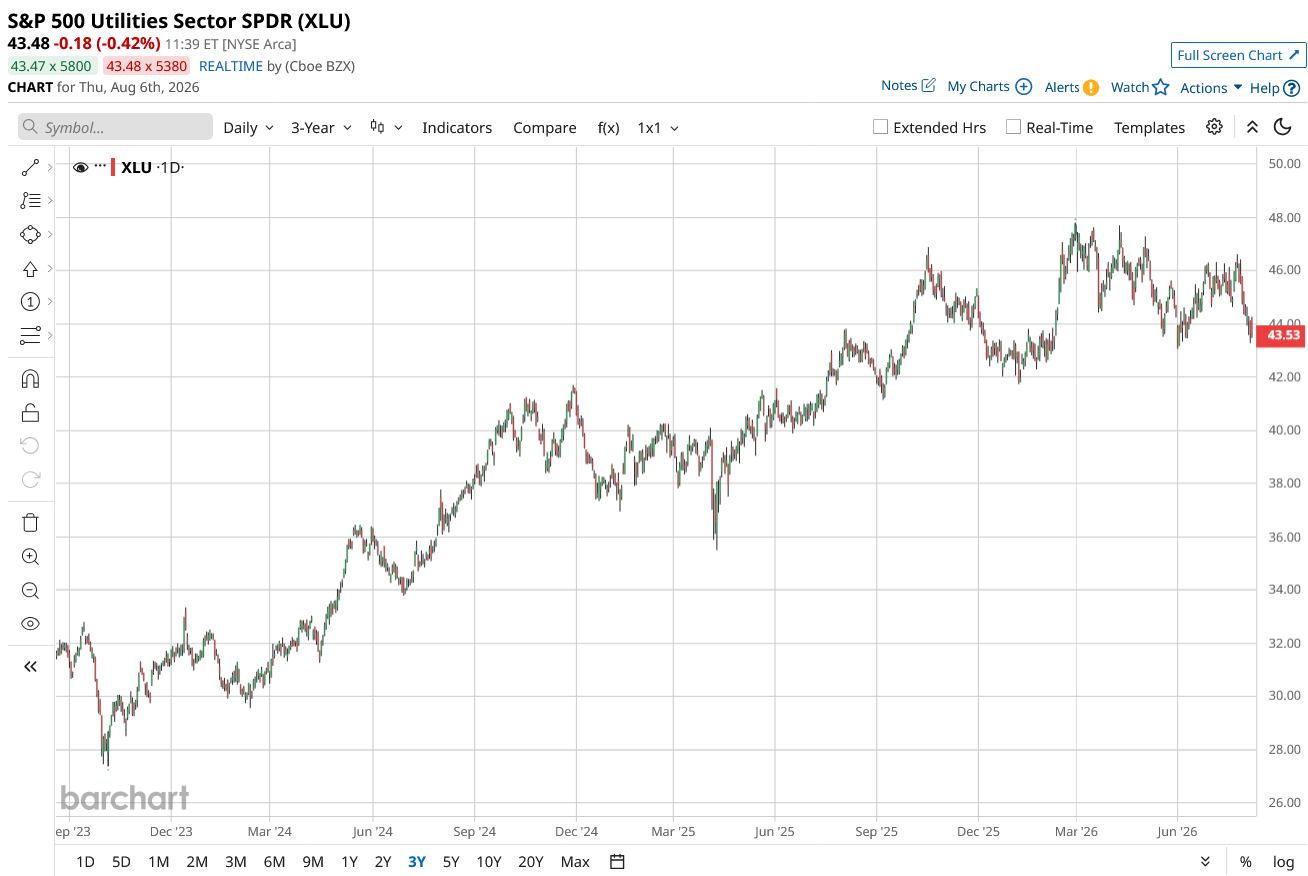
The simplest way to play the utility sector’s data center tailwind is by buying the State Street Utilities Select Sector SPDR ETF (XLU). The fund holds 31 S&P 500 companies across electric, multi-, gas, water, and independent power utilities, including NextEra Energy (NEE), Southern Company (SO), Duke Energy, Constellation Energy (CEG), and American Electric Power (AEP). XLU combines growth potential with defensive and income characteristics. Its holdings are expected to generate average annual earnings growth of about 9.7% over the next three to five years, while the fund offers a dividend yield of 2.71% and pays quarterly dividends. With an expense ratio of just 0.08%, XLU offers a low-cost way to gain diversified exposure to large U.S. utility companies.
If you prefer picking individual stocks, I believe DTE Energy (DTE) could be a compelling choice. CEO Joi Harris recently reaffirmed the company’s long-term outlook, stating, “We are confident in our long-term operating EPS growth rate target of 6% to 8% through 2030,” and added that “the Google data center project and other data center opportunities provide upside to this plan.” Morningstar analysts project average annual earnings growth of 7% through 2030, with the potential to exceed 8% if DTE secures a third hyperscaler data center customer later this year. It is also worth noting that DTE trades at a forward adjusted P/E of 18.38x, roughly in line with both the sector median and its five-year average, while prominent peers such as American Electric Power and Alliant Energy (LNT) trade at premiums to the sector median. In addition, DTE offers a dividend yield of 3.29%, higher than XLU’s yield. Finally, the stock currently trades at a key support level from which it has bounced several times this year. If that level holds, another rebound could offer investors attractive upside over the near term.
On the date of publication, Oleksandr Pylypenko had a position in: MSFT , GOOGL , AMZN , META . All information and data in this article is solely for informational purposes. For more information please view the Barchart Disclosure Policy here.
Contact Us
Contact Number :+852 3852 8500Webull Securities Limited is licensed with the Securities and Futures Commission of Hong Kong (CE No. BNG700) for carrying out Type 1 License for Dealing in Securities, Type 2 License for Dealing in Futures Contracts and Type 4 License for Advising on Securities.

English