
Dear SK hynix Stock Fans, Mark Your Calendars for October 8
SK hynix (SKHY) has emerged as one of the semiconductor industry’s clearest beneficiaries of the artificial-intelligence (AI) infrastructure boom. It ranks among the leading DRAM suppliers and dominates high-bandwidth memory (HBM), a key ingredient in AI accelerators. That positioning has already shown up in the numbers, with Q2 FY2026 revenue soaring 257% year-over-year (YoY).
However, Thursday, Oct. 8, could bring a different kind of catalyst. The lock-up period covering certain shares tied to SK hynix’s Nasdaq ($NASX) listing is scheduled to expire on that date, potentially increasing the amount of stock available for trading and adding to short-term volatility.
The company’s IPO, the largest foreign U.S. listing ever, involved 177.9 million ADSs, equivalent to 17.79 million common shares, with the prospectus imposing a 90-day selling restriction on the company and certain affiliates. Still, “unlocked” does not necessarily mean “sold.”
The expiration could create a supply overhang, but it does not change SK hynix’s underlying fundamentals. The company has already begun mass shipments of HBM4, is expanding production capacity, and has secured long-term agreements with approximately 10 customers.
With these growth drivers intact, the bigger question is whether SK hynix can sustain its momentum.
About SK hynix Stock
Based in Icheon-si, South Korea, SK hynix is a major global semiconductor company that researches, develops, manufactures, and sells memory and non-memory semiconductors. With a market cap of nearly $1.4 trillion, its product portfolio spans DRAM, NAND flash, SSDs, and mobile chip packages.
On Monday, July 13, its shares began regular trading on the Nasdaq under the ticker SKHY after a record-breaking debut. Before that, investors could trade the stock under the temporary when-issued ticker SKHYV on Friday, July 10. Since its Nasdaq debut, SKHY has delivered steady, if hardly explosive, momentum.
Despite stumbling about 4% this morning, the shares have jumped 7% over the past month and 1.2% over the past five trading sessions. The performance comes amid the company’s strong AI exposure, valuation, earnings expectations, and the approaching lock-up expiration.
Speaking of valuation, the stock is not exactly being offered at a bargain-bin multiple. SKHY stock is currently trading at approximately 3.89 times sales, above the industry average, reflecting a premium.
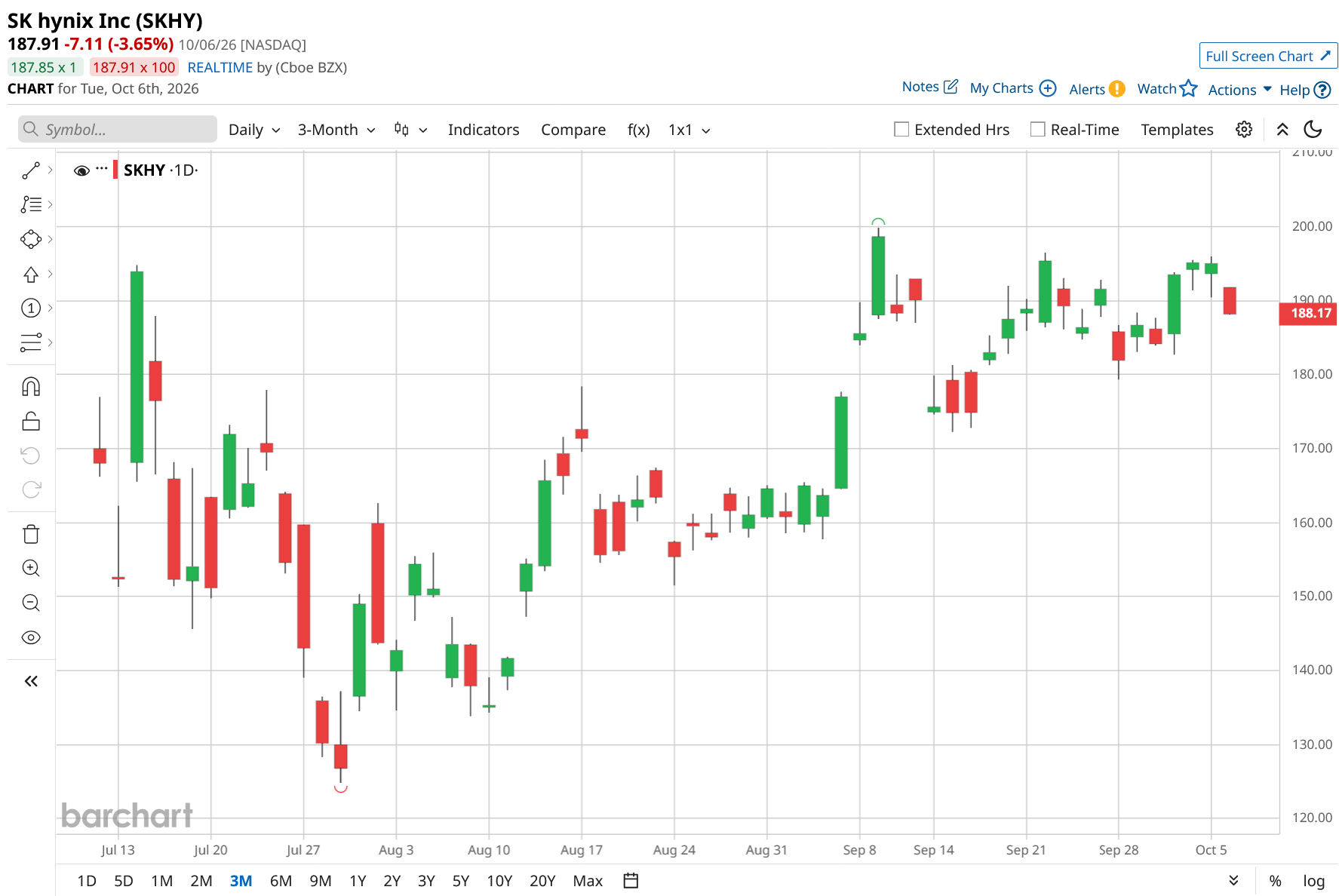
A Closer Look at SK hynix’s Q2 Earnings
The enthusiasm has plenty of financial ammunition behind it. On July 29, SK hynix reported another exceptional quarter, and investors responded by pushing the shares 17.5% higher in the following trading session. Q2 FY2026 revenue reached KRW 79.3 trillion ($56 billion), up 256.8% from the year-earlier period.
The bottom line was even more eye-catching. Operating profit jumped 557.2% from the year-ago value to KRW 60.5 trillion ($45 billion), while net income exploded 1,242.5% YoY to KRW 93.9 trillion ($69.9 billion). Those results represented the strongest quarterly performance in SK hynix’s history.
AI infrastructure spending supplied the horsepower. Demand for HBM, AI server DRAM, and enterprise SSDs remained exceptionally strong as data center operators continued expanding their AI capabilities. Higher memory prices provided an additional boost, allowing SK hynix to squeeze even more profitability from an already powerful demand environment.
The company is also approaching the next leg of its expansion with a remarkably strong financial cushion. At quarter-end, SK hynix held KRW 88 trillion ($65.5 billion) in cash against KRW 18.6 trillion ($13.84 billion) of debt. That left the company with a net cash position of KRW 69.4 trillion ($51.62 billion).
For a capital-intensive semiconductor manufacturer, that balance sheet is more than a comforting statistic. It gives management room to expand production without putting excessive pressure on its finances.
The earnings trajectory may still contain a few bumps. Analysts forecast Q3 FY2026 EPS to decrease 99.4% YoY to $5.96. The full-year outlook is dramatically stronger, with FY2026 EPS projected to rise 504.5% from the previous year to $25.69, while for FY2027, analysts expect EPS to gain 27.1% YoY to $32.66.
What Do Analysts Expect for SKHY Stock?
Wall Street’s optimism is being supported by several pieces of the semiconductor puzzle moving in SK hynix’s favor. Stronger AI-related memory demand, favorable DRAM pricing, and continued high-bandwidth memory (HBM) growth have improved the company’s prospects.
On that note, Simon Woo of Bank of America Securities has maintained a “Buy” rating and lifted his price target from $250 to $268.
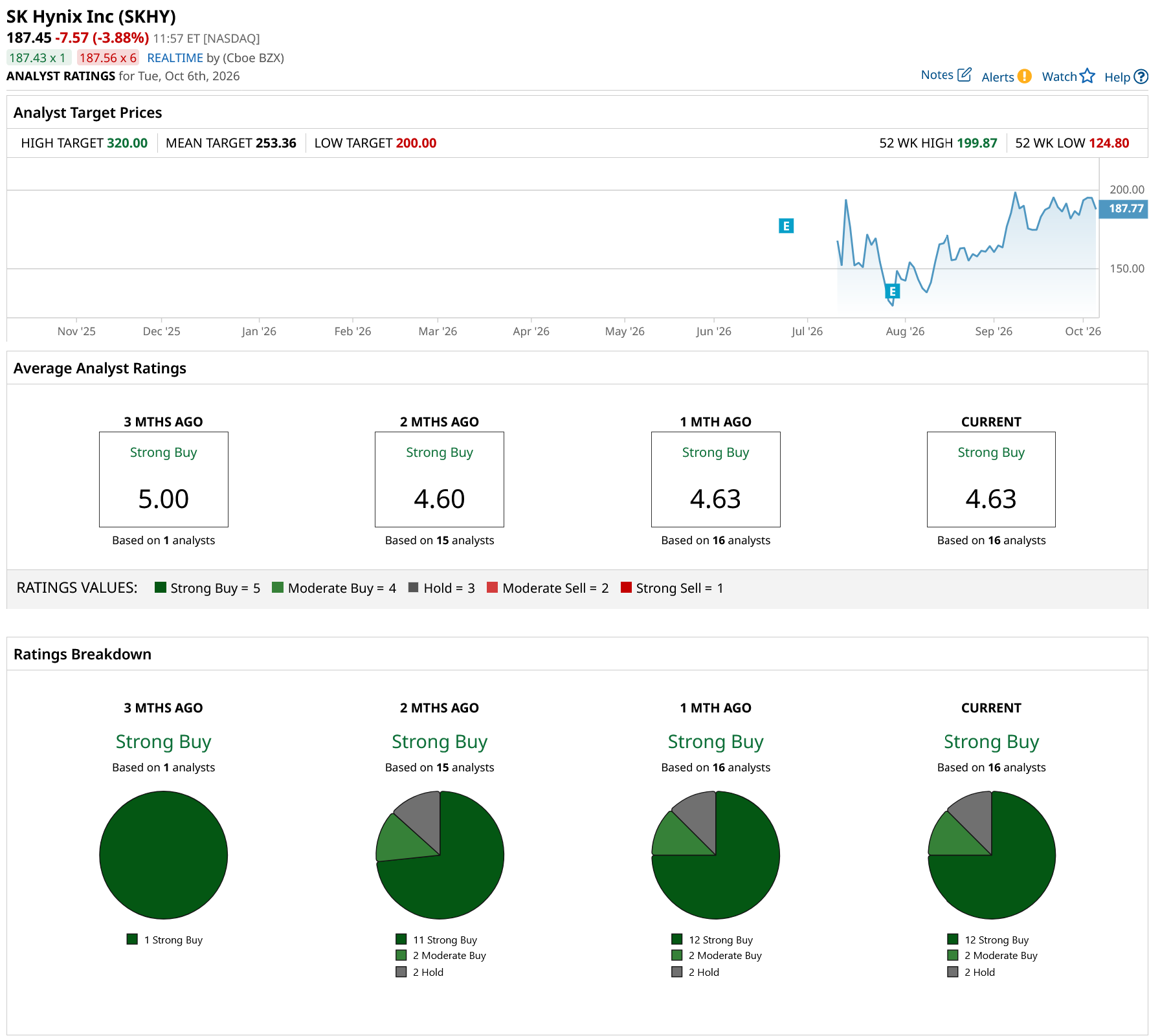
The broader analyst verdict is even more striking. SKHY stock has earned an overall Wall Street consensus rating of “Strong Buy.” Among the 16 analysts covering the stock, 12 recommend a “Strong Buy,” two recommend a “Moderate Buy,” and two suggest “Hold.”
The average price target of $253.36 implies a potential upside of 37%. Meanwhile, the Street-high target of $320 from Simon Coles of Barclays points to a possible gain of 73% from current levels.
On the date of publication, Aanchal Sugandh did not have (either directly or indirectly) positions in any of the securities mentioned in this article. All information and data in this article is solely for informational purposes. For more information please view the Barchart Disclosure Policy here.
Contact Us
Contact Number :+852 3852 8500Webull Securities Limited is licensed with the Securities and Futures Commission of Hong Kong (CE No. BNG700) for carrying out Type 1 License for Dealing in Securities, Type 2 License for Dealing in Futures Contracts and Type 4 License for Advising on Securities.

English