
Micron Stock Alert: Elon Musk Just Made The Bull Case Even Stronger
Elon Musk just gave Micron Technology (MU) a rare public compliment. The CEO of Tesla (TSLA) and SpaceX (SPCX) praised the memory chipmaker for keeping prices reasonable while rivals got greedy. That endorsement matters more than most investors realize.
Micron is in the middle of the AI memory bubble. The company's high-bandwidth memory is used in the chips inside Musk's own AI data centers. In the interim, Micron has secured long-term supply deals that will account for a vast majority of the revenue it yields in the months to come. The accolade from Musk is a simple statement. Fair pricing contributes to the customer loyalty that lasts over cycles.
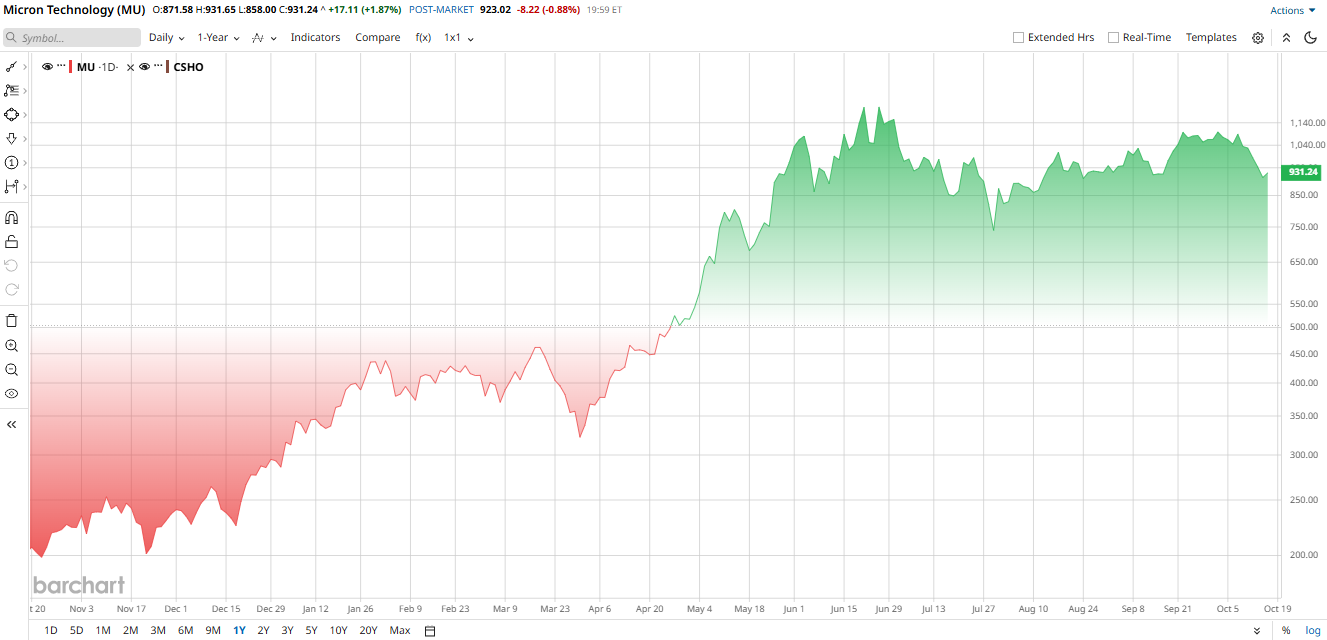
However, the sell-off in MU stock has been sharp recently due to fears about China. Chinese contender CXMT revealed advances with a next-generation DRAM design. That prompted investors to think about potential competition. It is a warning from Musk himself about China's manufacturing capacity. The shares dropped about 16% from recent highs in just a few sessions. This presents a fascinating contrast: peak cycle anxiety is being priced in, but the catalysts are quite apparent. AI data centers are devouring memory chips, and early 2026 saw an 80% to 90% increase in DRAM and NAND prices. Micron's income skyrocketed in each quarter.
Musk's Praise and the JPMorgan Note
Elon Musk shared a tweet on X stating that Micron has been reasonable in terms of future memory prices. He called the competitors extortionists. This is the smart thing that customers do for long-term loyalty, he said.
This is corroborated by a note from JPMorgan, which said Micron has signed 26 long-term supply deals with customers covering more than 35% of funding by 2030. The issuing of remaining performance obligations is valued at $150 billion. So far, $32 billion has already been committed in cash by customers, and over 75% of output for fiscal 2027 has already been sold.
That's a different story. Micron is not in a spot price cycle, but is securing its orders for several years in advance. JPMorgan thinks that such agreements may help margins beat previous cycle highs. The benchmark is a 62% gross margin.
Musk's xAI has huge AI data centers near Memphis, and the Nvidia (NVDA) GPUs installed there have Micron memory. A direct deal has not been announced; however, the relationship is genuine.
The China Threat Is Real but Overblown
The Chinese memory maker CXMT is set to ship server DDR5 by the end of 2026. This caused Micron and SK Hynix (SKHY) shares to plunge.
Jordan Klein of Mizuho said CXMT is just a paper tiger. There are seven reasons why the threat is exaggerated, among which is a tight time frame. Samsung's next similar products are planned to be available by 2028. This is the deadline for CXMT's claims. That gap matters.
“Please calm down, investors,” Rosenblatt told investors. The sell-off was “unjustified”, said the firm. CXMT's market share is still small. It would eventually account for 7.6% of the world's DRAM market in early 2026, up from 4.7% a quarter before. However, Micron is one of the leaders in the technology world.
The Latest Quarter Was Absurdly Good
Micron just reported fiscal fourth-quarter results for the period ended Sept. 3. The numbers are almost hard to believe. Revenue hit $54.23 billion, up 379% from $11.32 billion a year earlier. It also rose 31% from the prior quarter, marking the sixth consecutive record quarter.
DRAM revenue was the star. It jumped 343% year over year to $39.8 billion, making up 73% of total sales. High-bandwidth memory drove most of that growth. HBM is the specialized memory stacked next to AI processors.
Net income reached $37.70 billion while adjusted earnings per share came in at $33.42, crushing analyst expectations of $31.61. The company also generated $18.3 billion in adjusted free cash flow for the quarter. It ended the year with $73.48 billion in cash and investments, as Micron received $12.75 billion in customer contract deposits during the year.
CEO Sanjay Mehrotra said it best on the earnings call. "Micron's record fiscal Q3 financial results and even stronger outlook for Q4 reflect the strategic value of memory in the AI era."
Looking ahead, management guided first-quarter fiscal 2027 revenue to $61.5 billion, well above the $56.8 billion analyst estimate. Adjusted EPS is guided to $38.15. Analysts expected $37.9. For the full fiscal year, analysts project $274.54 billion in revenue and $177 in EPS. Susquehanna is even more bullish. The firm sees $284.56 billion in revenue.
What Wall Street Is Saying About MU Stock?
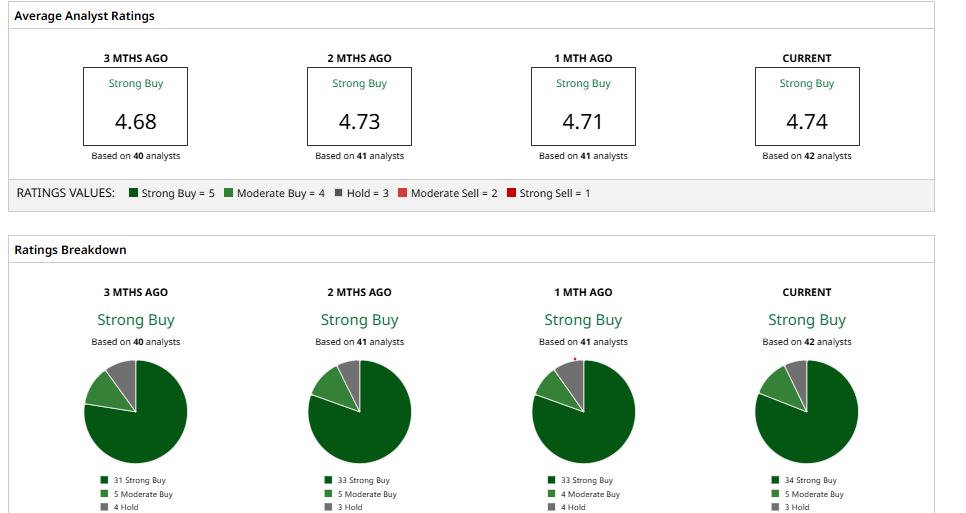
Analysts are overwhelmingly bullish on MU Stock. The consensus rating is “Strong Buy” based on 42 analysts. The average 12-month price target is $1,563. That implies 67.5% upside from current levels.
Separately, KeyBanc analyst John Vinh maintained a Buy rating with a $1750 target. He sees continued pricing strength in memory markets. Bank of America kept its Buy rating and $1550 target, citing tight supply and strong AI demand. JPMorgan maintained a Buy rating with a $1540 target, with analyst Harlan Sur writing, “the setup for memory is meaningfully stronger than 90 days ago.” D.A. Davidson also raised its target from $2100 to $3000. That is the most bullish call on the Street. The lowest target is $361. That spread tells you everything about the uncertainty. Bulls see a structural shift. Bears see a classic cyclical peak.
I think Micron sits in a fascinating spot. The basics are solid and have a good history. Long-term contracts give visibility, and Musk's backing makes it a lot more believable. On all measures, the valuation is a bargain.
The CXMT threat exists in the wild. As the Chinese scale rapidly, pricing power may dissipate. For now, however, the memory supercycle marches on.
On the date of publication, Nauman Khan did not have (either directly or indirectly) positions in any of the securities mentioned in this article. All information and data in this article is solely for informational purposes. For more information please view the Barchart Disclosure Policy here.
Contact Us
Contact Number :+852 3852 8500Webull Securities Limited is licensed with the Securities and Futures Commission of Hong Kong (CE No. BNG700) for carrying out Type 1 License for Dealing in Securities, Type 2 License for Dealing in Futures Contracts and Type 4 License for Advising on Securities.

English